A common misconception among DeFi power users is that all browser wallets are functionally equivalent: they hold keys, sign transactions, and let you interact with dApps. That’s true at a surface level, but it misses a critical layer of operational security that separates routine wallets from ones designed to reduce human error and mitigate protocol-level risk. Rabby Wallet focuses on forcing visibility into what a transaction will do before you approve it — and that design choice changes the calculus of risk in predictable ways.
This explainer drills into the mechanisms Rabby uses (transaction simulation, pre-transaction risk scanning, approval revocation), the trade-offs (complexity, residual attack surfaces, feature gaps), and the practical heuristics a U.S.-based DeFi user should adopt when evaluating whether Rabby fits into their security posture. If you want the download and basic install guidance, it’s available here.
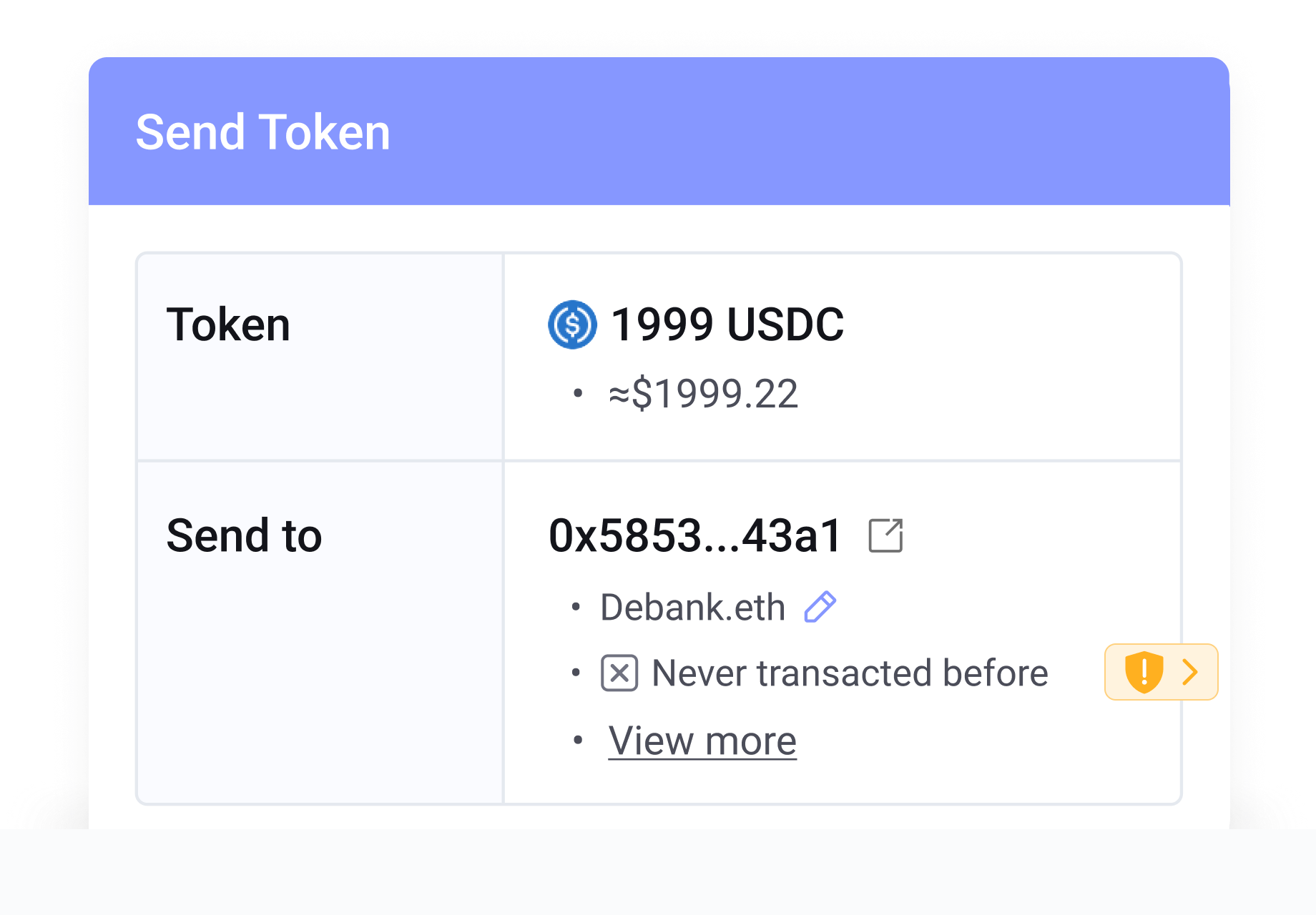
Mechanism: how Rabby makes the invisible visible
Two technical moves are central. First, Rabby simulates every transaction before signing it. That means the wallet runs the intended transaction on a local or remote node to compute the exact token movements and gas costs the action will cause. For users, the result is a precise preview of balance deltas rather than an opaque “confirm” dialog. Second, Rabby runs a security engine that checks the destination contract and approval targets against known risk indicators: previously exploited contracts, suspicious approval sizes or infinite approvals, and non-existent recipient addresses. The combination reduces the classic “blind signing” problem where users approve actions without a tractable mental model of the consequences.
Mechanistically, simulation is complementary to open-source code and hardware integration. Because Rabby is MIT-licensed and supports hardware wallets (Ledger, Trezor, Keystone and others), the simulation output can be independently observed and signatures can be delegated to an air-gapped device. That mix is important: simulation tells you what will happen; a hardware signer limits what can be signed without explicit physical confirmation.
Why that matters in practice — scenarios and mental models
Consider two scenarios common on US retail DeFi desks. Scenario A: interacting with a new DEX on Polygon that requests token approvals. Without simulation you only see an “approve” call; with Rabby you can see the exact allowance and whether it matches the dApp’s claimed behavior. Scenario B: a smart contract redirect or malformed recipient address. Rabby’s pre-transaction scanner can flag nonexistent recipient addresses, which often accompany phishing or UI-redirect attacks.
These are not mystical protections. They are engineerable defenses against two failure modes: social-engineering that tricks users into approving dangerous allowances, and supply-chain or front-end compromise where the dApp’s UI requests an unintended destination. For DeFi power users who do frequent, high-value operations, the marginal value of prevented mistakes compounds quickly.
Where Rabby strengthens security — and where it does not
Strengths:
– Transaction simulation reduces human error by turning an uncertain approval into a quantified outcome.
– Pre-transaction risk scanning surfaces red flags tied to known compromises.
– Built-in approval revocation and portfolio aggregation give operational visibility over persistent exposures.
– Hardware wallet support and multi-sig integrations (Gnosis Safe, Fireblocks) let users combine automation with institutional custody controls.
– Automatic network switching reduces accidental transactions on the wrong chain, a surprisingly common loss vector.
Limitations and boundary conditions:
– Simulation is only as strong as the node and block-state used; off-chain state, mempool manipulations, or race conditions can still produce different on-chain results. In short: simulation reduces, but does not eliminate, time-of-execution risk.
– Rabby does not have a native fiat on-ramp or in-wallet staking. For users who want a single app for buy-in and yield management, Rabby will require additional services.
– Past incidents matter. In 2022 Rabby Swap’s associated contract was exploited for about $190,000. The team froze the contract and compensated users, which shows operational response capacity, but the incident illustrates that security incidents can happen even with a security-focused product. Independent audits and responsible disclosure are helpful but not foolproof.
Trade-offs: security ergonomics versus surface complexity
Rabby’s approach makes decisions explicit, which improves safety but increases cognitive load. Power users will appreciate granular balance deltas and revocation tools, but those same details can create noisy alerts for high-frequency traders or bots — leading to potential “alert fatigue.” There is also a subtle trade-off in automation: automatic network switching reduces mistakes, yet it can hide the underlying RPC or provider a user is connected to, which matters if you want to verify a provider’s reliability or audit logs for compliance.
Another trade-off concerns centralization risk in tooling: Rabby’s security engine relies on datasets of flagged contracts and heuristics. If those signals are incorrect or delayed, false negatives and false positives will occur. Because Rabby is open-source, independent researchers can audit and contribute, but this relies on active community scrutiny.
How to use Rabby within a larger DeFi security framework
For serious DeFi users in the US, Rabby is best thought of as one layer of defense. Practical heuristics:
– Treat simulation outputs as a conditional prediction: check for nonce, gas, and expected token deltas, then cross-verify the dApp’s UI and contract source when stakes are large.
– Never rely solely on a single approval. Use Rabby’s revocation to limit allowances to known minimums and to revoke unused approvals periodically.
– Combine Rabby with hardware wallets or multi-sig for treasury-level or institutional holdings; that pairing materially reduces single-key compromise risk.
– For on-ramps and custody, accept that Rabby currently requires external services (exchanges, fiat ramps) and does not provide native staking; plan workflows accordingly.
What to watch next — conditional signals and implications
Watch for two categories of developments that would change Rabby’s value proposition. First, enhancements in oracle and node infrastructure to reduce simulation/real-execution divergence—if wallets can simulate with better real-time state fidelity, the confidence in pre-sign checks rises materially. Second, integrations: if Rabby adds a vetted fiat on-ramp or native staking with audited smart contracts, it will close current usability gaps but introduce additional attack surfaces (payments rails, custody partners). Both are technically feasible, but each brings governance and compliance trade-offs.
Another signal: sustained community audits and third-party red-team reports. Because Rabby is open-source, independent security research that produces patches or confirmations will increase its trustability. Conversely, repeated classes of front-end phishing or supply-chain attacks that bypass simulation would highlight the limits of client-side defenses.
FAQ
Does Rabby prevent smart contract exploits?
No wallet can guarantee prevention of smart contract vulnerabilities. Rabby reduces exposure by flagging known compromised contracts and preventing blind signing via simulation, but it cannot stop novel contract logic bugs or developer-introduced exploits. The wallet reduces operational risk, not protocol risk.
Can I use Rabby with a Ledger or Trezor?
Yes. Rabby supports major hardware wallets (Ledger, Trezor, Keystone, CoolWallet, and others). Using Rabby as the UI while requiring hardware confirmations combines the visibility of simulation with the tamper-resistance of a physical signer.
Is Rabby suitable for institutional multi-sig setups?
Rabby integrates with multi-sig and institutional custody solutions (Gnosis Safe, Fireblocks, Amber, Cobo). For institutional workflows, Rabby can provide the interface and pre-checks while custody and signing remain controlled by enterprise-grade solutions.
What are the biggest operational caveats for U.S. users?
U.S. users should note Rabby currently lacks an in-wallet fiat on-ramp and native staking. Also, regulatory and compliance frameworks affecting fiat gateways or institutional custody may influence which integrations become available domestically. Operationally, pair Rabby with compliant on-ramps and follow custodian guidance when needed.